Maturity · Health · Expansion — a working CS playbook for Suger's book
Dico Angelo · Suger Customer Success Manager (Implementation & AI Enablement) · April 2026
What the data is actually telling us
Context · 316 customers · $5.05M ARR
Before scoring anything, I interrogated the dataset. Three findings reframed the rest of my work:
110 / 316
Customers with zero activity in last 6 months (35%)
142 / 221
Contracts already past contract_end_date (64% of dated contracts)
238 / 316
Customers with no cs_team_sentiment captured (75%)
Data hygiene is the first CSM problem here. 64% of contracts with dates are "expired" yet many are still transacting tens of millions through Suger. Before I score anything, I'd confirm with Kyle: are these auto-renewed, month-to-month, or did they actually churn and we never updated the record? The answer changes every number below by ±20%.
Signals I built on top of the raw data
Activity trend ratio
offers_last_1_month ÷ (offers_last_6_months ÷ 6). >1 = accelerating, <1 = cooling. Built for offers, co-sell, and disbursement to see momentum vs. raw volume.
Renewal runway
Days from today (2026-04-17) to contract_end_date. Binned into 0-30 / 31-90 / 91-180 / 180+ for CSM cadence.
Active-customer flag
Any offer, co-sell, or disbursement in last 6 months. Filters out the 35% of accounts that signed but never went live.
ARR-weighted risk
(100 − health_score) × ln($ARR). Drives outreach prioritization — avoids sending the top CSM to the smallest accounts.
Instructions noted 318 customers; the sheet has 316 populated rows (2 trailing blanks). All figures use the 316 valid rows.
Q1 · Marketplace Maturity Model
Analysis
Why maturity ≠ ARR
ARR tells you what a customer pays. It doesn't tell you whether they've actually figured out how to sell through cloud marketplaces. For an Implementation CSM, the right axis is operational depth: how many marketplaces they've integrated, whether they're running real GTM motion (offers + co-sell), and whether that motion is producing disbursed revenue.
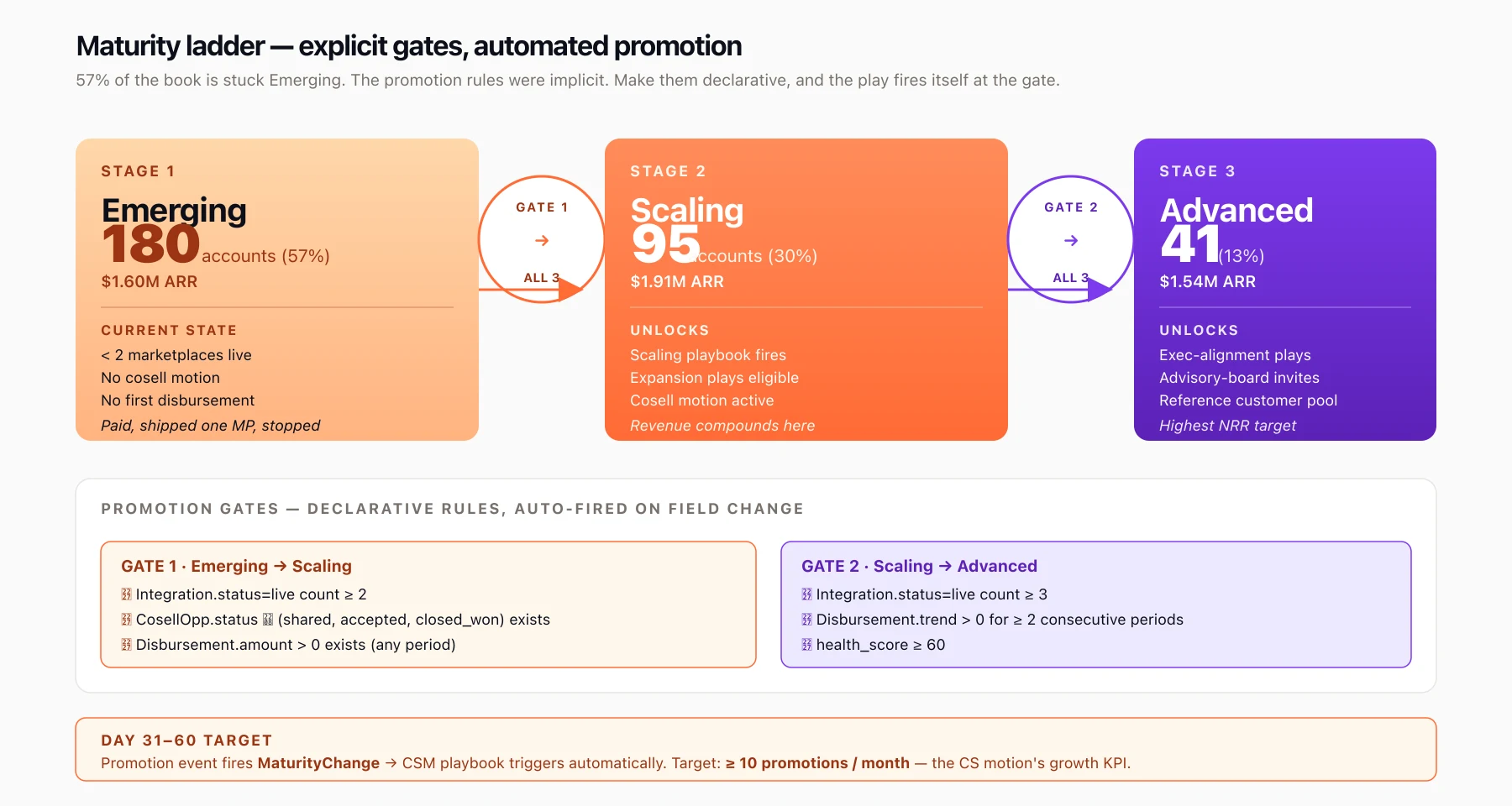
The 3-tier model (rules are transparent, explainable, repeatable)
Tier
Rule
Count
Book ARR
Advanced
marketplaces ≥ 2 AND disburse_yr ≥ $500K AND offers_yr ≥ 10
41 (13%)
$1.54M (31%)
Scaling
marketplaces ≥ 1 AND disburse_yr ≥ $50K OR offers_yr ≥ 5 AND cosell_yr > 0
95 (30%)
$1.91M (38%)
Emerging
Everyone else — signed, but not meaningfully transacting
180 (57%)
$1.60M (31%)
Three exemplars — one per tier
Customer #196 Advanced
$71,907 ARR
2 marketplaces, 134 offers/yr, 448 co-sells/yr, $38.2M disbursed/yr. Running real volume — this account IS their marketplace motion. Contract expired 103 days ago: confirms my earlier hygiene flag.
Customer #180 Scaling
$59,606 ARR
1 marketplace, 67 offers/yr, 895 co-sells/yr, $7.3M disbursed/yr, excellent sentiment. Crushing it on one channel — Advanced is one integration away. Renewal is today (0 days). See Q3 for the expansion play.
Customer #8 Emerging
$10,556 ARR
Signed May 2023, 1 marketplace, 1 offer all year, $0 disbursed, good sentiment. Classic stalled implementation. Renewal in 24 days — if we don't move now, they churn in a hidden renewal.
CSM strategy per tier
Emerging
Goal: first disbursement. Run a standardized 30-day activation playbook. This is where AI-agent-led onboarding earns its keep — no CSM hand-holding until Cohort Jump to Scaling.
Scaling
Goal: 2nd marketplace + co-sell velocity. Quarterly business review, dedicated CSM pod, enablement workshops. Biggest ARR bucket ($1.91M) — highest lift for the business.
Advanced
Goal: lock in multi-year, enterprise features, become the reference customer. Named CSM + exec sponsor, joint QBR with AWS/Azure PDMs, case study pipeline.
Rollout plan for the maturity framework itself
Week 1: Tag all 316 accounts with tier; review with Kyle + Sophia for outliers.
Week 2: Reconcile the 142 "overdue" contracts — we cannot act on a maturity tier if the contract status is wrong.
Week 3–4: Retro-assign coverage by tier (pooled CSM for Emerging; named CSM for Scaling/Advanced).
Week 5+: Feed the tier tags into Suger's AI agents so onboarding content auto-scopes to maturity.
Q2 · Customer Health Score — Methodology
Analysis · scoring model
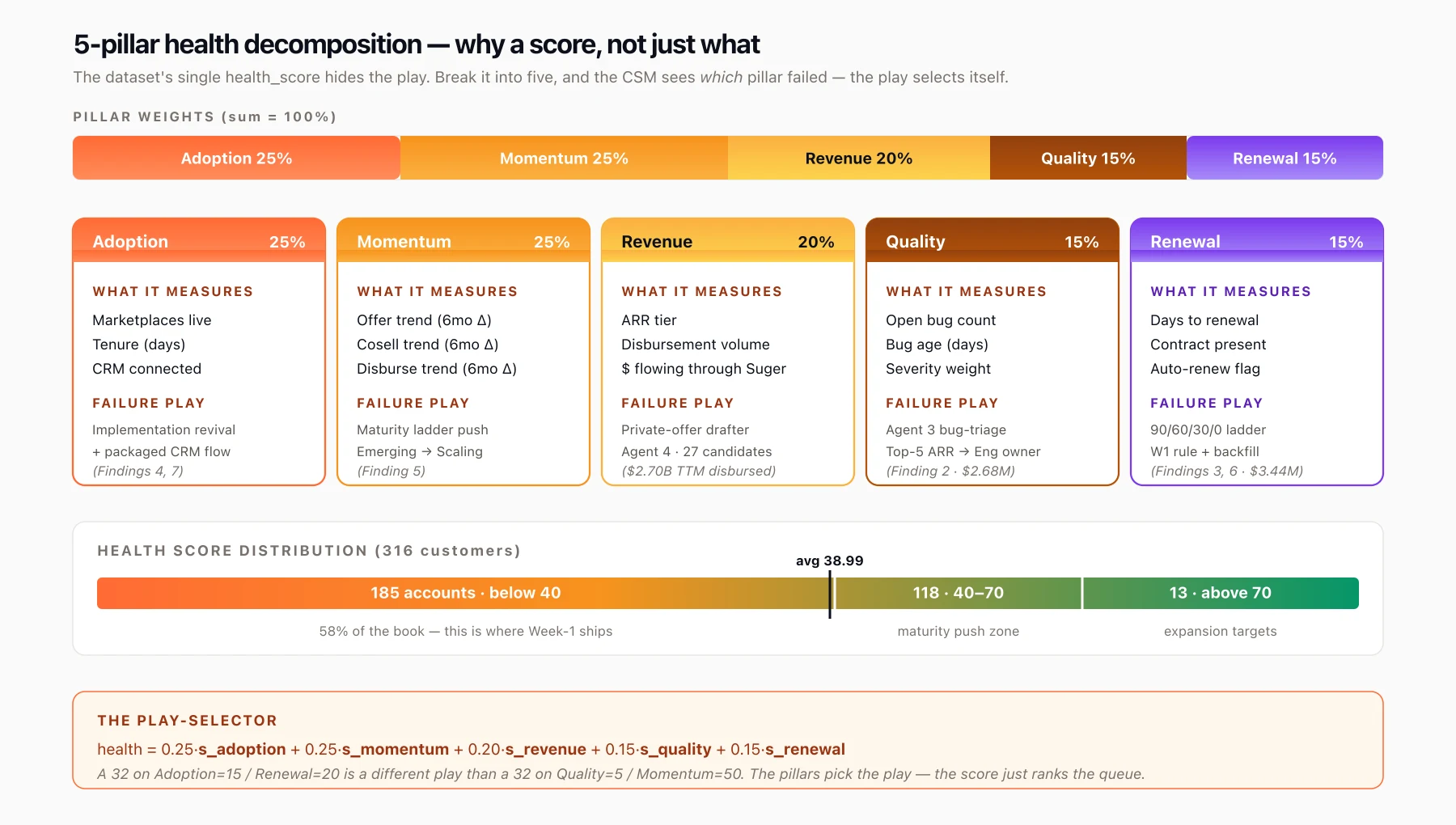
A health score is a prioritization tool, not a dashboard decoration. Mine has to (a) be defensible when a customer asks why, (b) drive daily CSM workload, and (c) be improvable by the AI agents over time. Five pillars, each scored 0–100 and blended.
If they aren't using the product, nothing else matters.
Momentum
25%
1mo vs. expected-flat rate across offers/co-sell/disburse
Trend predicts churn earlier than raw volume does.
Revenue flow
20%
log(disburse_6mo) percentile rank
Disbursement is the proof of value — customers renew when money moves.
Sentiment / QA
15%
CS sentiment - bug count (capped −40)
Leading indicator of escalation risk; bug load is a tax on their team.
Renewal runway
15%
Days to contract_end
Forces the score to reflect urgency, not just quality.
What the distribution looks like
39
Average health score
185
Customers below 40 (at-risk)
13
Customers above 70 (healthy)
$1.81M
ARR at risk (health < 40)
Designed to be learnable. Every pillar is transparent and its weight is a tunable parameter. As Suger's AI agents capture outcomes (renewals, expansions, churn), the weights should be re-regressed quarterly against actual retention — the model gets sharper as the book gets larger.
Q2 · Who I engage first — and the 30-day plan
Recommendation
Raw priority score surfaced Emerging accounts near renewal with zero activity. Those matter — but the single most urgent account in the book is hidden by a strong top-line score.
Customer #196 AdvancedImmediate
$71,907 ARR · 2nd largest account in book
Health score
66.9 (misleadingly high)
Revenue percentile: 98 · Adoption percentile: 86
Contract status
Expired 103 days ago
Still transacting $22M/6mo with no renewed paper
Momentum
Accelerating (+76 pts)
1-mo offers run-rate is 6× the 6-mo average
Sentiment
Unknown (last interaction: 123 days ago)
CS has no line of sight on our biggest volume account
Why this is the #1: they are generating $38.2M in disbursed revenue per year through Suger, on an expired contract, with no CS coverage for 4 months. This is a legal, commercial, and CS risk simultaneously. If a competitor calls them this quarter, they have no switching cost and no advocate.
30-day plan for Customer #196
Days
Action
Owner
Exit criteria
0–2
Pull the account file with Kyle; confirm contract status with Legal / Sales ops; block any overdue invoicing risk.
CSM + Kyle + Legal
Paper status confirmed (expired / auto-renewed / churned-in-system).
3–7
Intro outreach from CSM + AE — "we noticed the contract lapsed and want to make sure you're set up to keep running." Discovery call scheduled.
CSM + AE
Discovery call on calendar with the revenue owner, not just procurement.
8–14
Discovery call: map current workflows (they have 2 marketplaces — which third is next?), gather sentiment, review support tickets.
Renewal + expansion proposal: multi-year, add 3rd marketplace, include AI-assisted offer creation as a lever.
CSM + AE
Proposal delivered with mutual close plan.
22–30
Stabilize: weekly standing sync, feed their workflow patterns back into Suger's AI agents as reference data.
CSM + Product
Signed multi-year paper OR clear escalation path; customer becomes a reference.
Weights I used, restated for this account
The Revenue Flow (20%) and Adoption (25%) pillars rightly gave #196 a strong score. What the score understates is hidden contractual risk — which is why I recommend a sixth signal (contract status: active / expired / auto-renew) added to the model in v2. Expired contracts with live usage should cap health at 50 regardless of other inputs.
Q3 · Expansion target & the pitch
Analysis · Recommendation
Customer #10 AdvancedExpansion-ready
$43,951 ARR · Excellent sentiment · 75 days to renewal
Integrations
2 marketplaces
Room for a third.
Offers (1/6/12 mo)
2 / 23 / 44
Steady motion, accelerating last month.
Co-sell (1/6/12 mo)
6 / 27 / 115
Real partner motion.
Disbursed (6mo)
$4.22M
Top 3% of book on revenue flow.
Bugs / sentiment
5 bugs · excellent
They are happy and know they're getting value.
CRM connected
Yes
Low-friction to add a 3rd channel.
Hypothesis: three-lever expansion in one motion
Third marketplace integration. They're running 2 hyperscalers today. Adding the one they don't have (usually GCP or Alibaba depending on their ICP) captures net-new pipeline without asking them to change how they sell.
Multi-year renewal with ramp. 75 days to renewal is the perfect window. Price should reflect the step-up in volume their $4.22M/6mo disburse implies — but protect it with a 2-yr commit so they don't feel it as a hit.
AI agent access tier. They have disciplined co-sell motion; they are the right design partner for Suger's AI-assisted offer generation. Upsell + product feedback loop in one SKU.
Rollout plan for this expansion
Days
Action
Success signal
-75 to -45
Joint discovery with AE: confirm which 3rd marketplace matches their buyer motion; get the AWS/Azure PDM on the call.
3rd marketplace confirmed, PDM warm.
-44 to -21
Technical integration scoped; AI agent tier demoed against their own workflow.
Signed SOW on integration; proposal in legal review.
-20 to 0
Close renewal + expansion together. Do not separate them — renewing with a price bump without upside is a churn invitation.
Multi-year signed, ramp schedule clear.
+1 to +90
Implementation on 3rd marketplace; design-partner cadence on AI agent; reference-customer agreement.
1st offer live on new marketplace inside 60 days.
Nine more expansion candidates identified
Same filter (health ≥ 60, adoption ≥ 60, positive sentiment, < 3 marketplaces, disbursed > $100K/6mo) surfaced 10 total candidates. The full ranked list is in the enriched data file. #10 is the cleanest story to pitch first; the rest are a sequenced pipeline for Q2–Q3 CY2026.
How this all rolls out — and how it teaches Suger's AI agents
Operationalization
90-day operating plan
Phase
Actions
Outcome
Days 1–14 · Stabilize
Fix the data hygiene gap (142 overdue contracts). Confirm sentiment coverage for top-20 ARR. Tag all 316 accounts with maturity + health score.
One source of truth. No more "big account, no CS coverage" surprises.
Days 15–45 · Prioritize
Immediate engagement on Customer #196 (expired whale). Renewal motion on the 55 accounts renewing in 90 days. Standardized Emerging activation playbook deployed to the 180 Emerging accounts.
$1.8M at-risk ARR addressed; activation rate for Emerging > 30% in cohort.
Days 46–90 · Scale
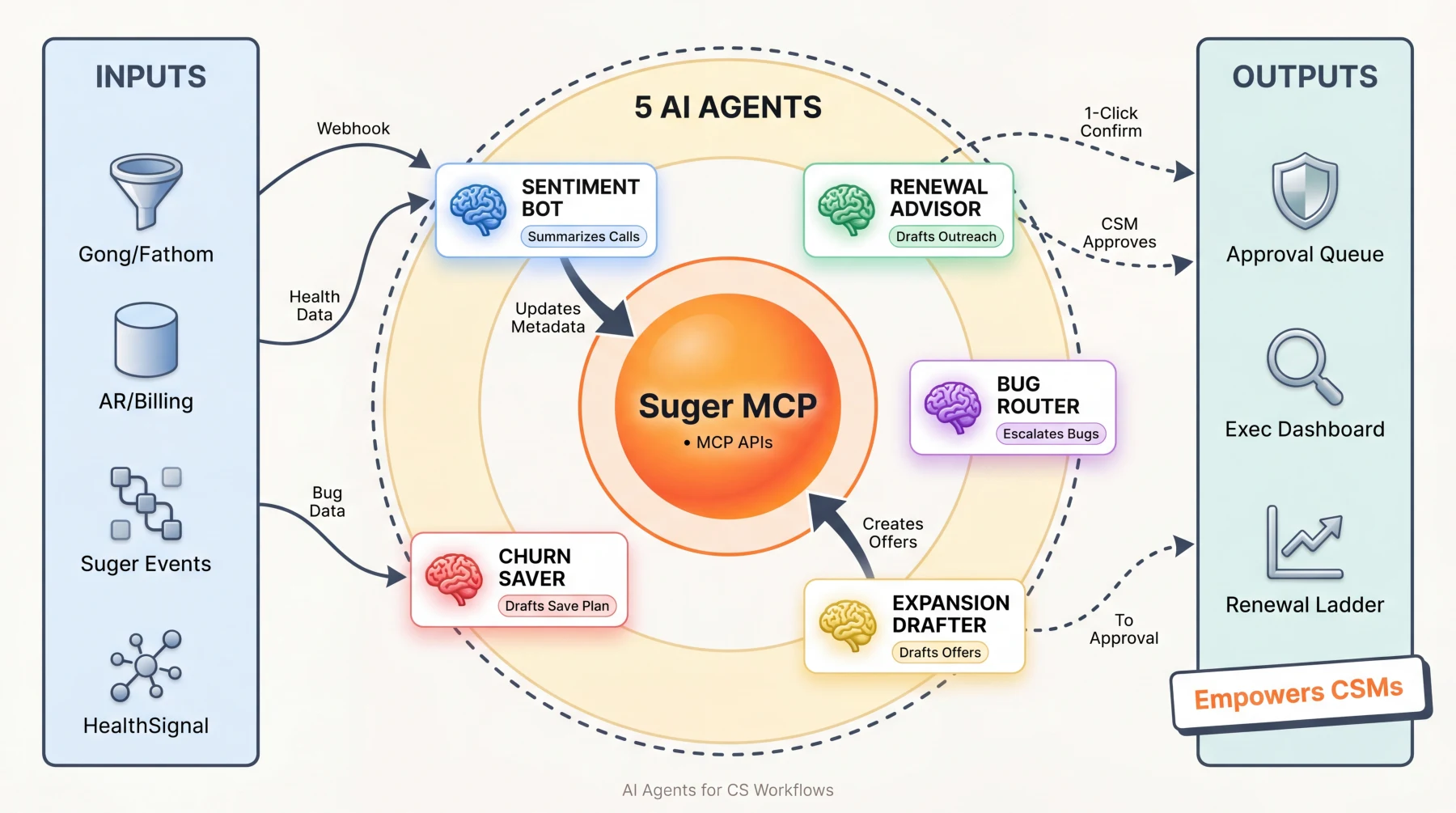
Roll the playbook into Suger's AI agents. Every CSM action (outreach, training module, onboarding checklist) is captured as structured feedback so the agents can execute the next 100 Emerging accounts autonomously.
Reduced manual onboarding load. Activation becomes a product capability, not a CSM headcount problem.
The AI-enablement loop (this is the part I'm most excited to own)
CSM captures
Structured notes on what worked per maturity tier: "Emerging + GCP → training module A; Scaling + AWS → co-sell webinar."
Agent learns
Next customer tagged Emerging + GCP gets module A auto-offered in onboarding. Weights in health score re-regressed against retention monthly.
CSM leverages
CSM time shifts from repetitive onboarding to exception handling and expansion — the high-trust, high-judgment work.
Definition of done (12 months): A new Suger customer can reach first disbursement with minimal CSM touch. CSM intervention is targeted at accounts flagged by the health score, not at every onboarding. That's how a ~50-person team services 250+ customers and scales past 1,000.
Visual appendix — the CS operating system in 7 diagrams
One diagram per answer
Seven SVGs, each mapped to one question. They are the source of truth for the written answers above.
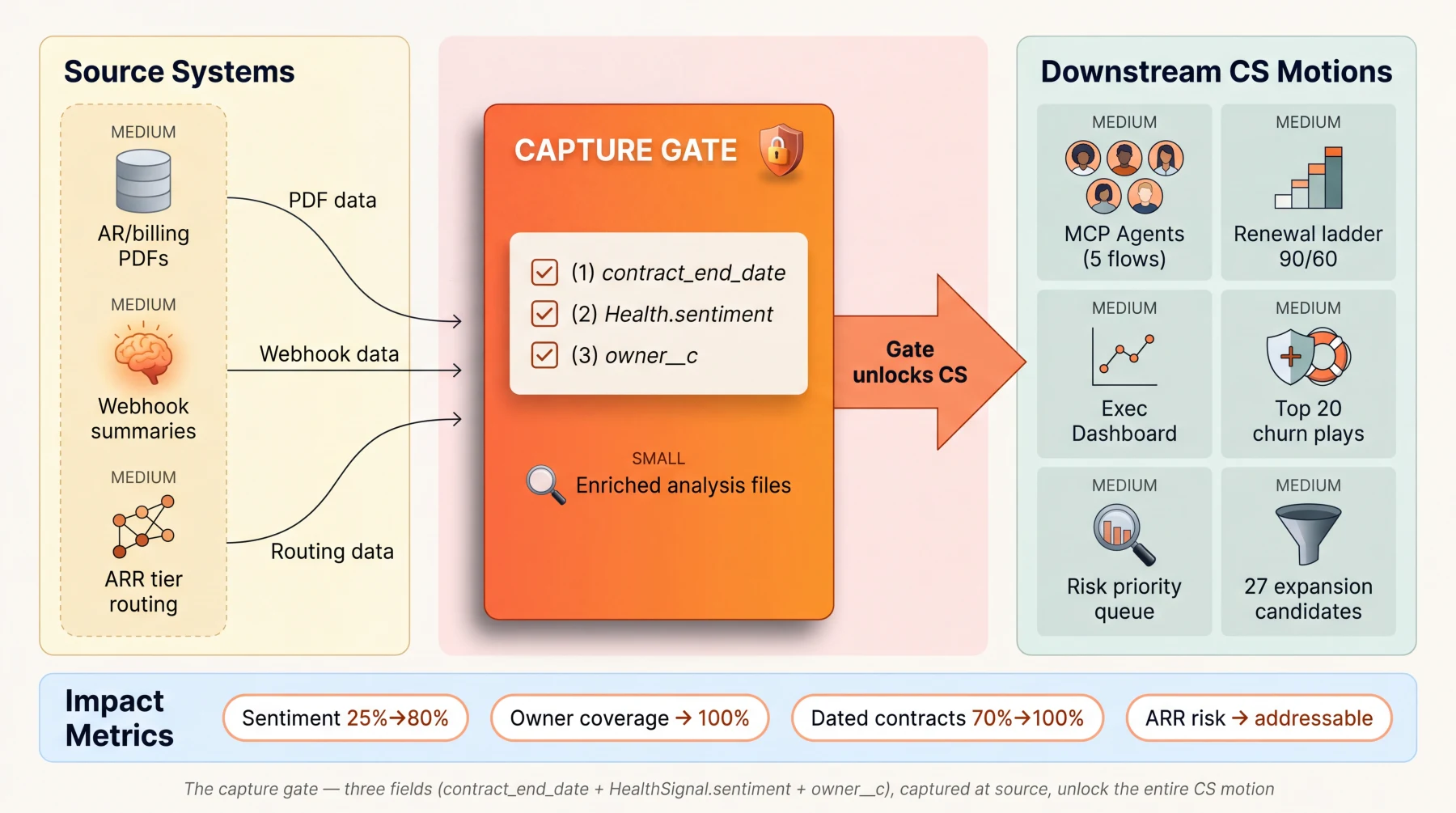
01 · Thesis
contract_end_date + HealthSignal.sentiment + owner__c — every downstream play is gated on these three.
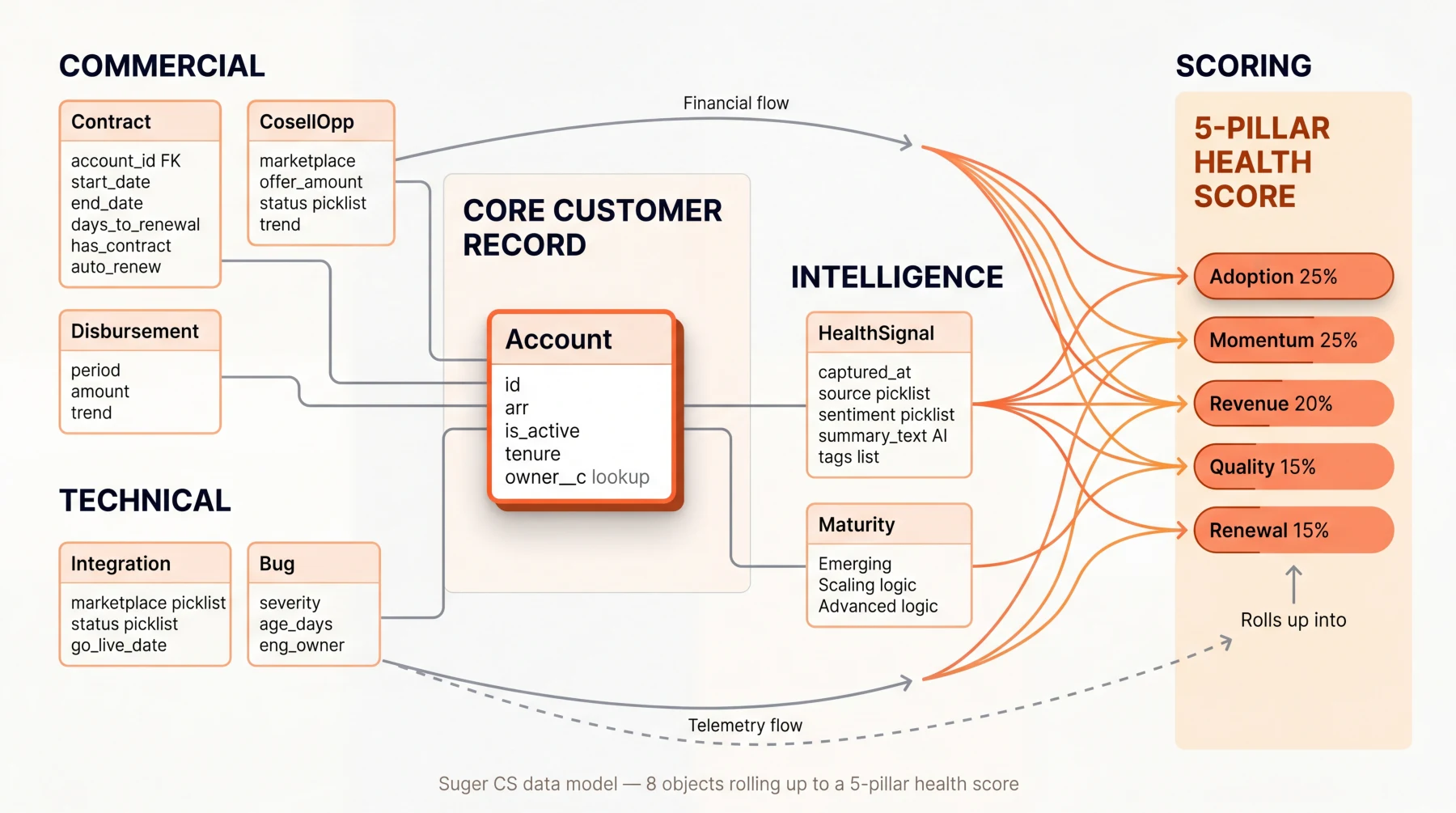
02 · Data model
The 8 objects a CSM works against. Every field maps to a play.
03 · Health
Adoption 25 · Momentum 25 · Revenue 20 · Quality 15 · Renewal 15. The why behind a low score.
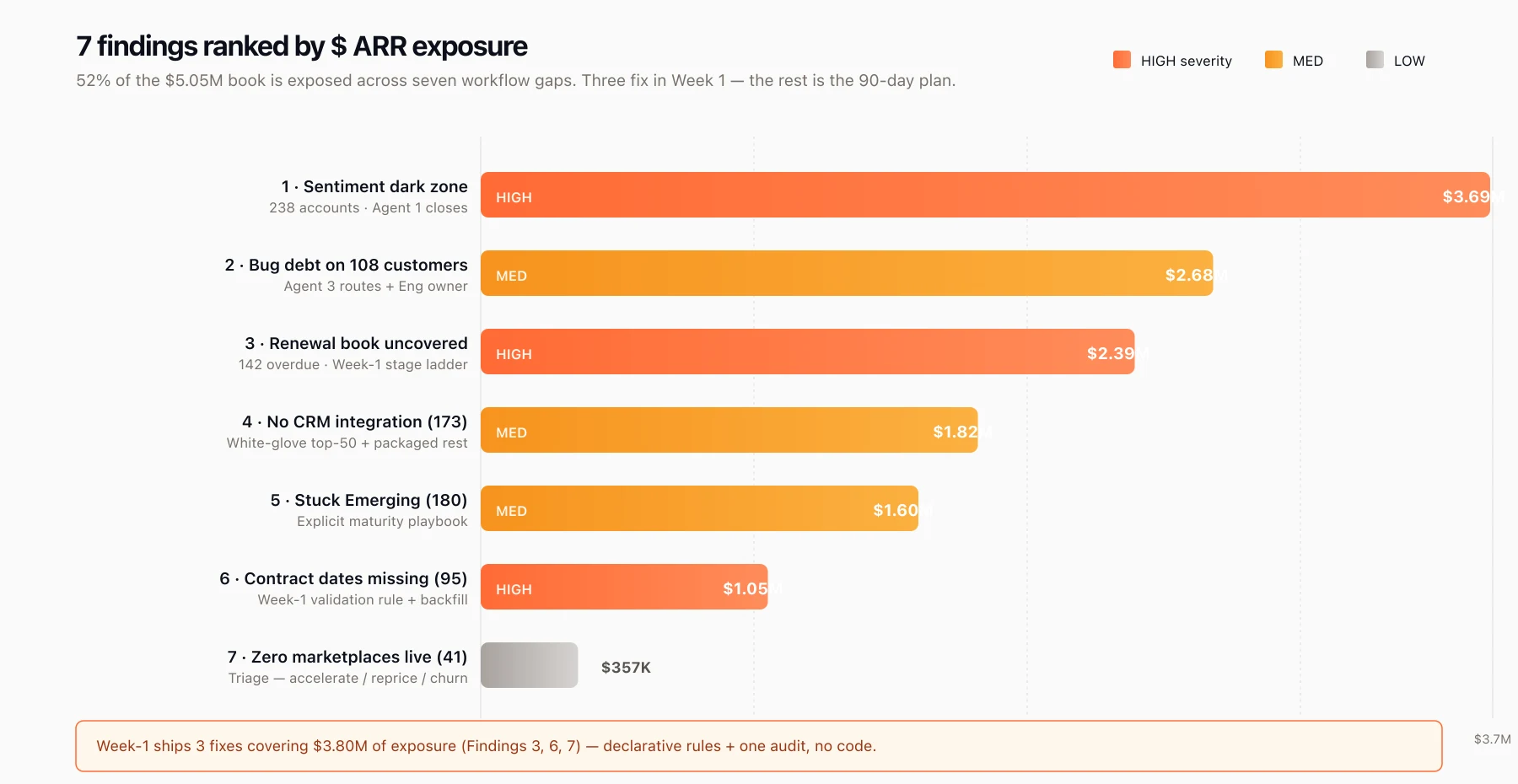
04 · Findings
$2.61M of $5.05M is exposed. Week-1 ships 3 of 7 — $3.80M addressable.
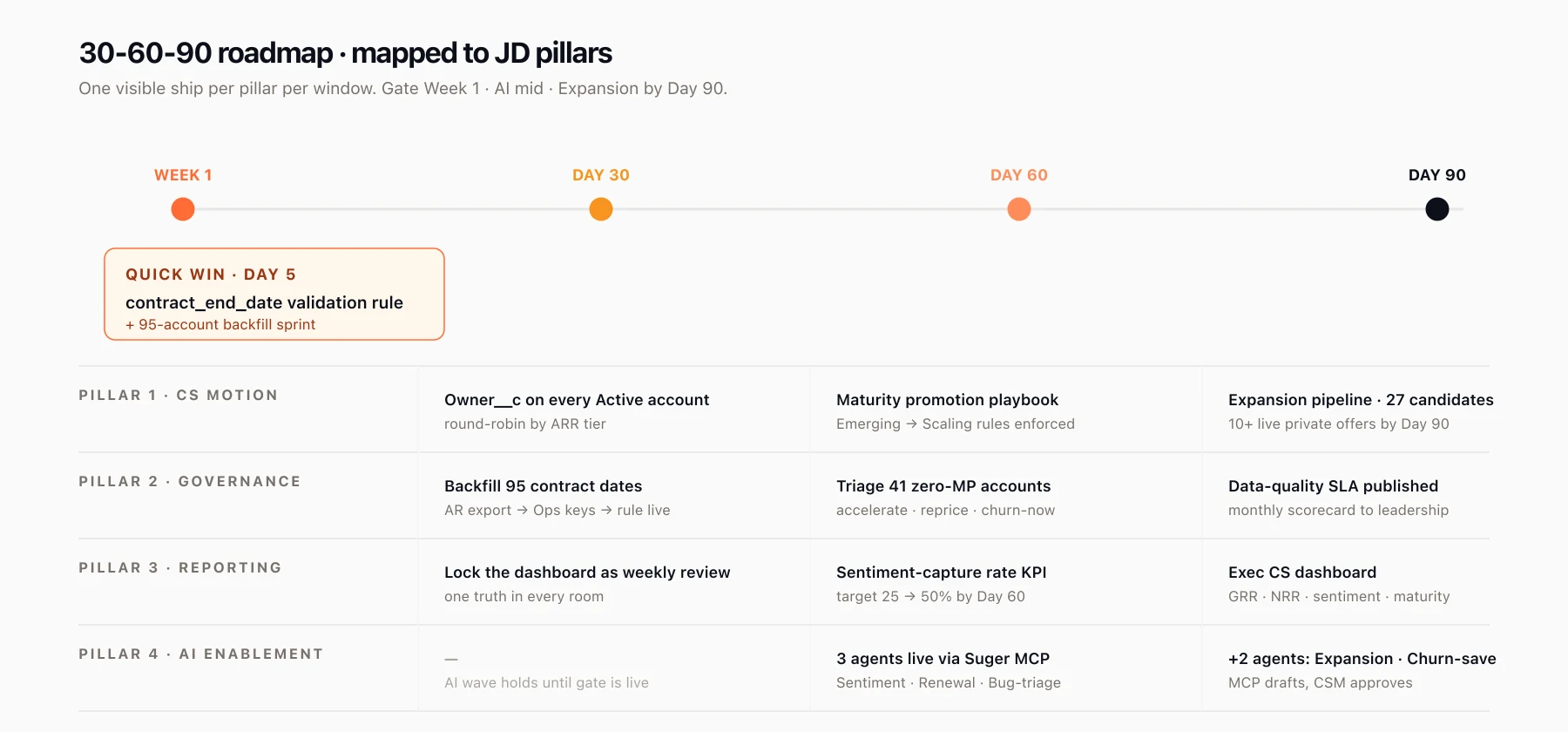
One visible ship per pillar per window. Gate Week 1 · AI mid · Expansion by Day 90.
All SVGs authored for this submission. Source files live at takehome/diagrams/*.svg alongside the written answers.
What I'd validate before going live
Questions I'd ask on Day 1
The 142 overdue contracts — data hygiene, auto-renewal mechanic, or hidden churn? This changes every number in this deck.
CS sentiment coverage — why is 75% of the book "unknown"? Is it new accounts, or accounts without named CSMs?
Bug count semantics — are these product bugs, integration issues, or customer-reported support tickets? Customer #104 has 47; the distribution is very skewed.
The 110 zero-activity accounts — are they pre-go-live, paused implementation, or logo'd but never scoped? The answer defines whether this is a CSM problem or a sales-qualification one.
ARR grain — is $ARR current committed, billed, or forward? A $10K account with $38M disbursed raises this question immediately.
These aren't "gotchas" — they're the exact questions I'd bring to the first CS staff meeting. The take-home surfaces a portfolio that looks risky on the surface, but the real risk (or opportunity) is that we haven't figured out yet what the data actually means.
Appendix — supporting files submitted:
enriched.csv — all 316 customers with maturity, health score, pillar sub-scores, risk, expansion flag.
summary.json — portfolio-level statistics.
top_priority.csv / expansion_candidates.csv / churn_candidates.csv / maturity_exemplars.csv — ranked shortlists used to pick the exemplar customers above.